
Have you ever wondered what’s considered a “good” FFMI for your gender? You see charts and numbers online, but it’s often unclear how they apply to you. It’s a common question for anyone serious about tracking their fitness progress.
The reality is, men and women naturally differ in muscle mass and body composition. Because of this, their Fat-Free Mass Index (FFMI) ranges are not the same. Understanding these differences is key to setting realistic goals and accurately measuring your hard-earned muscle gains.

What Is FFMI and Why Gender Matters
Let’s start with the basics. The Fat-Free Mass Index (FFMI) is a measurement that calculates your lean muscle mass relative to your height. It helps you understand your body’s muscle-to-height ratio, which is a far better indicator of fitness than just your total weight.
Here’s the truth: a universal FFMI chart doesn’t work. A gender FFMI comparison is essential because men and women have different physiological makeups. Applying the same standards to both would be misleading and discouraging. Gender-specific ranges give you a much more accurate picture of your progress.
FFMI for Men — Average and Ideal Scores
For men, FFMI is an excellent way to track muscular development. The scores provide a clear roadmap from an average build to an elite natural physique. Knowing where you stand can help you set powerful and achievable goals.
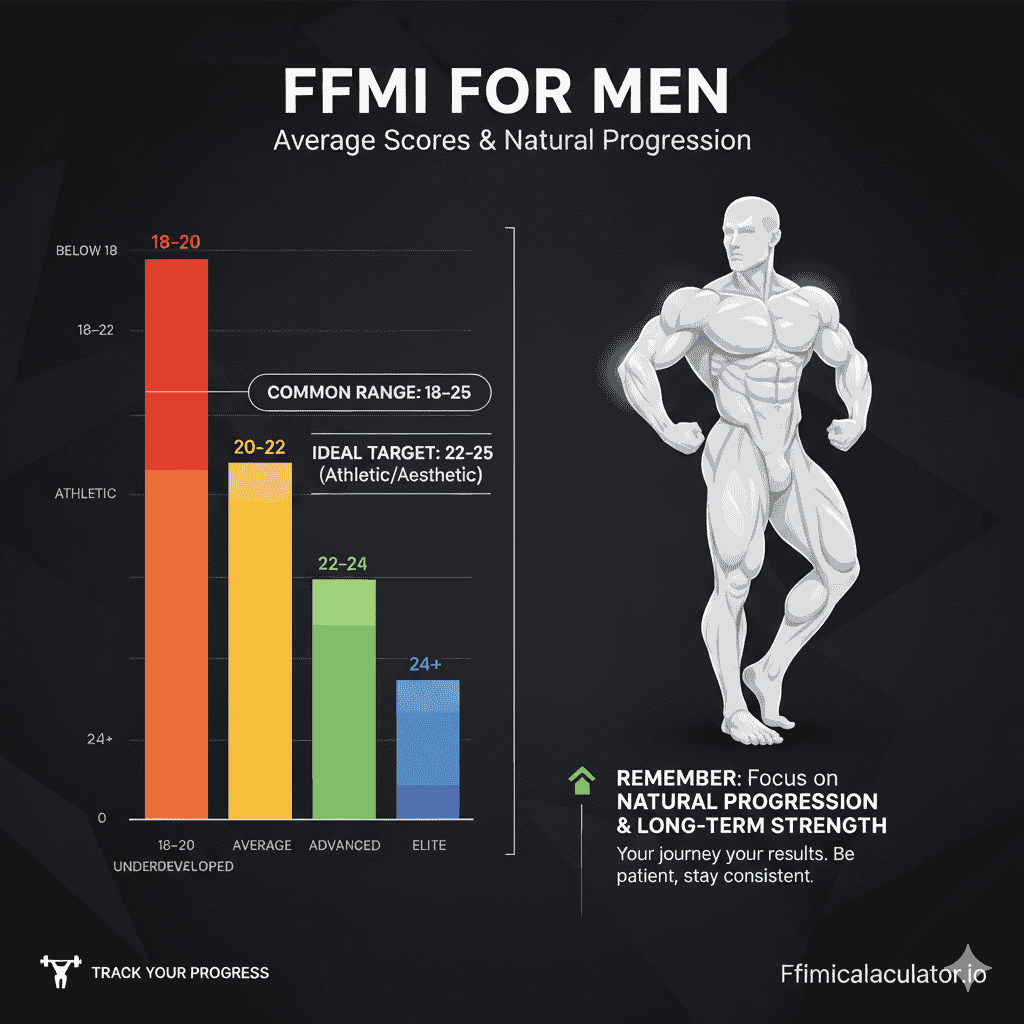
Let’s break this down with a simple chart for the average FFMI score and ideal FFMI range for men.
| FFMI Range | Category | Meaning |
|---|---|---|
| 16–17 | Below Average | Indicates low muscle mass for your frame. |
| 18–19 | Average | Typical for a healthy, non-lifting individual. |
| 20–22 | Athletic | Shows a fit and consistently trained physique. |
| 23–25 | Muscular | Represents an elite natural physique. |
| 25+ | Likely Enhanced | A score very difficult to achieve naturally. |
Most men who train consistently with weights will find themselves in the 20–23 FFMI range. This is a fantastic achievement that shows clear dedication. Pushing into the 23–25 range is a sign of exceptional genetics and years of hard work. An FFMI for men above 25 is often considered the natural limit.
If your FFMI is above 23, you’re likely in the top 10% of natural lifters. It’s a score to be proud of.
FFMI for Women — Average and Ideal Scores
FFMI for women works the same way, but the numbers are different. Women have higher levels of essential body fat and different hormonal profiles, which results in naturally lower FFMI values. However, the progress and dedication required to reach higher scores are just as impressive.
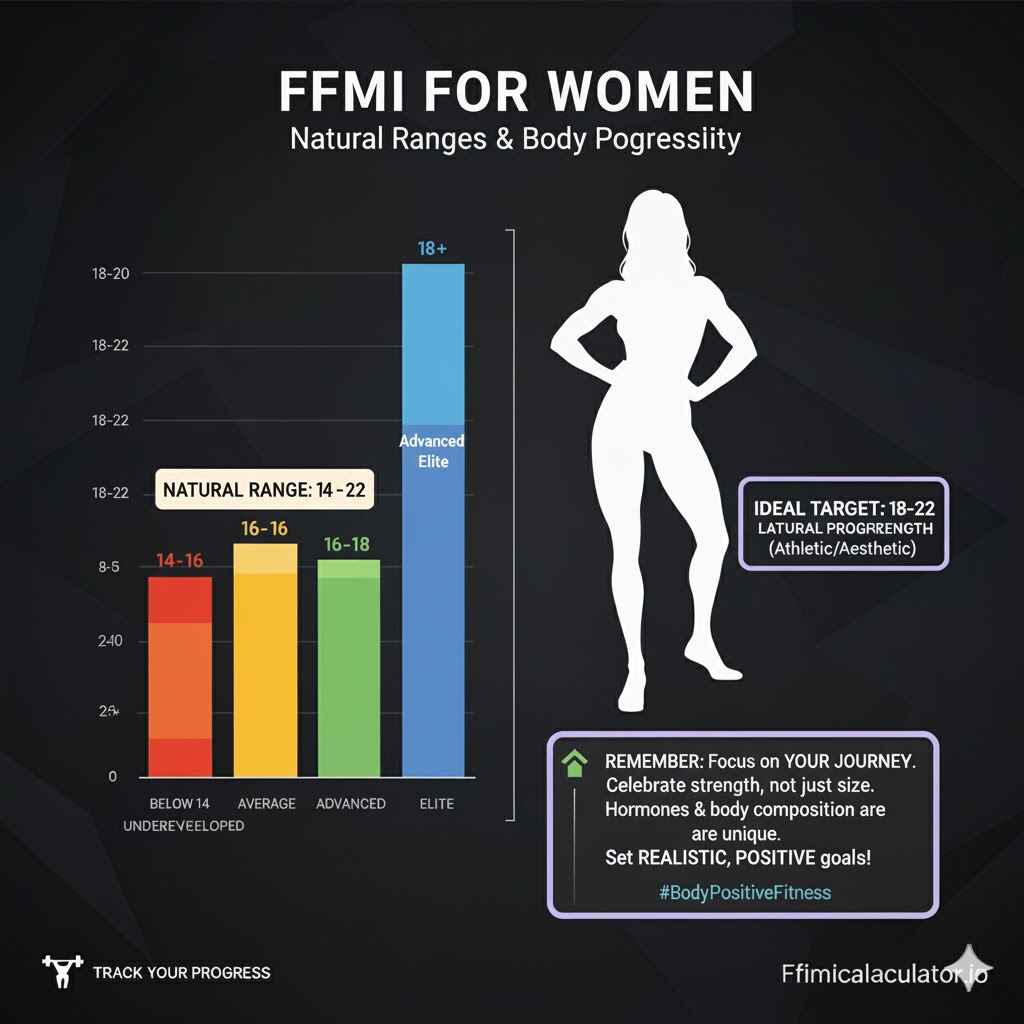
Here is a look at the FFMI scores for women:
| FFMI Range | Category | Meaning |
|---|---|---|
| 13–14 | Below Average | Suggests a lower level of lean mass. |
| 15–16 | Average | A normal and healthy range for most women. |
| 17–18 | Athletic | Represents a fit, toned, and strong physique. |
| 19–21 | Muscular | Typical for a highly trained female athlete. |
| 22+ | Exceptionally Muscular | A level that is beyond the typical natural limit. |
A common mistake is to compare the FFMI for women directly to men’s scores. A 17 FFMI for a woman is equivalent to a 22 for a man. Both scores show a strong, athletic build that is the result of consistent effort in the gym and kitchen. Reaching an FFMI of 19 or more as a woman is a sign of elite-level fitness.
Ready to find out where you stand? You can use our free FFMI Calculator to get your score instantly.
Why Men Have Higher FFMI Scores
The difference in the ideal FFMI range between genders is rooted in biology. It’s not about effort or potential, but about fundamental physiological distinctions.
The primary reason is testosterone. Men produce significantly more testosterone than women, and this hormone plays a crucial role in muscle protein synthesis, the process of building new muscle. This hormonal advantage allows men to build and maintain more muscle mass.
Other factors include muscle fiber density and body fat distribution. Men tend to have a higher percentage of lean mass, while women naturally carry a higher percentage of essential body fat, particularly for reproductive health. These biological realities are why a gender FFMI comparison is so important for setting fair and accurate benchmarks.
How to Improve FFMI for Both Genders
Regardless of gender, the principles for improving your muscle-to-height ratio are the same. It all comes down to a consistent and intelligent approach to training and nutrition.
- Focus on Resistance Training: This is the most important step. Following a structured workout program with progressive overload will stimulate muscle growth.
- Eat a High-Protein Diet: Consume enough protein to support muscle repair. Aim for 1.6 to 2.2 grams of protein per kilogram of body weight.
- Perform Regular Body Checks: Don’t just rely on the scale. Use a tape measure and photos to track visual changes in your body composition.
- Recalculate Your FFMI: Check your FFMI every 4-6 weeks to ensure your plan is working and to stay motivated on your journey.
Knowing your numbers is the first step to improving them. You can learn more about what to aim for by reading our guide on what counts as a Good FFMI Score.
FFMI vs BMI for Men and Women
For years, the Body Mass Index (BMI) has been the standard for assessing health. However, it’s a flawed metric for active individuals. BMI can’t distinguish between fat and muscle, often mislabeling fit men and women as “overweight” simply because their muscle mass makes them heavier.
FFMI provides a much fairer assessment for both genders. It rewards you for building a strong, lean body by focusing on your fat-free mass. For anyone who lifts weights or plays sports, FFMI is the superior choice for tracking body composition.
Final Thoughts
FFMI is a realistic and motivating tool for measuring your fitness progress. It moves beyond the limitations of BMI and provides a true reflection of your muscularity.
Remember that men and women have unique ranges. Your progress should be measured by your own consistency and improvements, not by comparing your numbers to someone else’s. The journey is about becoming a stronger version of yourself.
Take the first step today. Calculate your FFMI and start tracking your progress with a metric that truly understands your hard work.
FAQs
What’s an average FFMI for men and women?
An average FFMI score for men is typically between 18 and 19. For women, an average score is between 15 and 16. These ranges represent a healthy but generally untrained physique.
Why do women have lower FFMI scores than men?
Women have naturally lower FFMI scores due to biological differences. These include lower testosterone levels, a higher percentage of essential body fat, and different muscle fiber characteristics.
Can women reach an FFMI above 20 naturally?
Yes, it is possible for highly dedicated female athletes with excellent genetics to reach an FFMI of 20 or 21 naturally. This represents an elite level of muscularity.
What’s considered an elite FFMI score?
An elite FFMI score for natural male lifters is in the 23–25 range. For natural female lifters, an elite score is in the 19–21 range. These scores require years of dedicated training and nutrition.
How often should you check your FFMI?
It is best to check your FFMI every 4 to 6 weeks. This frequency is enough to see meaningful changes without getting bogged down in daily fluctuations. It helps you stay on track and make adjustments to your plan as needed.
Leave a Reply