
You’ve been hitting the gym for months, maybe even years. You’re stronger, your clothes fit differently, and you can see new muscle in the mirror. But then you ask yourself a simple question: Is my progress actually good? It’s a common thought for anyone serious about fitness. You want a real way to measure your gains, not just go by how you feel.

This is where the Fat-Free Mass Index (FFMI) comes in. It’s a powerful tool that answers the question of how muscular you truly are for your height. FFMI helps you understand your body composition on a deeper level, moving beyond just the number on the scale. It provides a clear muscle-to-height ratio, giving you a benchmark for your hard work.
What Does FFMI Measure?
In simple terms, the Fat-Free Mass Index measures how much muscle you have relative to your height. It isolates your lean body mass—which includes muscles, bones, and organs—from your fat mass. This is a huge step up from just looking at your total weight, which can be very misleading.
Here’s the truth: two people can have the same height and weight but look completely different. One might have a high body fat percentage, while the other is lean and muscular. FFMI accounts for this by requiring your body fat percentage in its calculation. It gives you a score that directly reflects your muscularity. If you’re new to this concept, our FFMI vs BMI comparison explains why this metric is far superior for athletes.
Understanding aGood FFMI Score?
So, what exactly is a good FFMI score? It’s not a one-size-fits-all answer. A “good” score depends on several factors, including your gender, genetics, and how long you’ve been training. A beginner’s ideal FFMI range will look very different from that of an elite athlete.
Men naturally carry more muscle mass than women, so their FFMI scores will be higher. Genetics also play a big role in your potential for muscle growth. Some people are just born with a framework that allows them to pack on muscle more easily. Finally, your training experience matters. The longer and more consistently you train, the higher your FFMI score is likely to be.
FFMI Score Chart (Men & Women)
To give you a clearer picture, we can break down FFMI scores into different categories. This FFMI chart helps you see where you stand and what you can aim for. Remember, these are general guidelines, but they provide an excellent reference point.
Now let’s break this down for both men and women.
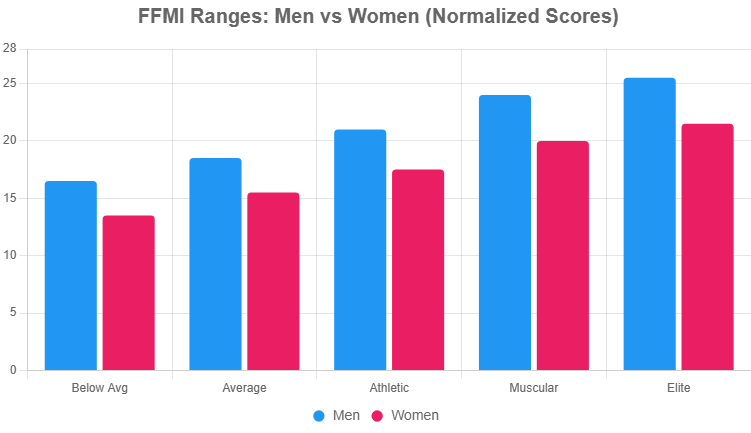
FFMI for Men
For men, a good FFMI score reflects a solid amount of muscle mass. Here’s how the numbers typically stack up:
| FFMI Score | Category |
|---|---|
| 16–17 | Below Average |
| 18–19 | Average |
| 20–22 | Athletic |
| 23–25 | Muscular |
| 25+ | Enhanced or Exceptionally Gifted |
An average, non-lifting man will usually fall in the 18-19 range. Once you start training seriously and consistently, you can push into the athletic and muscular categories. Reaching an FFMI of 23 or higher signifies a very impressive and well-developed physique that stands out.
FFMI for Women
The ideal FFMI range for women is naturally lower than for men due to hormonal and physiological differences. However, the same principles of progress apply. Here is a general FFMI chart for women:
| FFMI Score | Category |
|---|---|
| 13–14 | Below Average |
| 15–16 | Average |
| 17–18 | Athletic |
| 19–21 | Muscular |
| 22+ | Exceptionally Muscular |
An FFMI for men and women differs, and that’s perfectly normal. For women, a score in the 17–18 range indicates a strong, athletic build. Pushing into the 19–21 range means you have achieved a level of muscularity that is noticeable and well above average.
The Natural FFMI Limit
A common question is, What’s the highest FFMI score I can achieve naturally? This brings us to the concept of the natural FFMI limit. Based on research and analysis of elite natural bodybuilders from before the steroid era, a consensus has formed around this topic.
For men, the natural FFMI limit is generally considered to be around 25. For women, it’s around 22. Let’s be honest—very few people naturally exceed these numbers. Reaching or surpassing this threshold often suggests either a top-tier genetic predisposition for muscle growth or the use of performance-enhancing substances. This natural FFMI limit provides a realistic ceiling for what most people can aim for with dedication.
What’s a Healthy FFMI Range?
While it’s exciting to think about the maximum limit, it’s more practical to focus on a healthy and achievable FFMI range for your experience level. Your goal should be progressive improvement.
Here’s a look at some realistic targets:
- Beginners (less than a year of consistent training): Men can aim for an FFMI of 17–19, while women can target a score of 14–15. This range indicates you are building a solid foundation.
- Intermediates (1–3 years of training): Trained men can realistically achieve an FFMI of 20–23. Women in this category can shoot for a score between 16 and 18. This shows significant progress and an athletic physique.
- Elite Naturals (5+ years of dedicated training): With years of hard work, elite natural men can reach an FFMI of 23–25. Elite women can achieve an impressive score of 19–21. This represents the peak of natural potential for most.
Setting goals based on these stages helps you stay motivated and track your progress effectively. The key is consistency over time.
How to Improve Your FFMI Score Naturally
Improving your FFMI score comes down to building lean muscle mass while managing body fat. There are no shortcuts, but a few fundamental principles will drive your success. You can improve your muscle-to-height ratio with a smart approach.
Here are four actionable tips:
- Prioritize Protein: Protein is the building block of muscle. Aim to consume between 1.6 to 2.2 grams of protein per kilogram of your body weight each day to support muscle repair and growth.
- Focus on Progressive Overload: To build muscle, you must consistently challenge your body. This means gradually increasing the weight, reps, or sets in your workouts over time.
- Get Enough Sleep: Muscle growth happens when you rest, not when you train. Aim for 7–9 hours of quality sleep per night to allow your body to recover and rebuild.
- Manage Stress and Recovery: High stress levels can hinder muscle growth by increasing cortisol. Make time for active recovery, like stretching or walking, and manage stress through mindfulness or hobbies.
Following these tips will put you on the right track to boosting your score.
Final Thoughts
FFMI is without a doubt one of the most accurate ways to measure your muscularity. It cuts through the noise of the bathroom scale and tells you what you really want to know: how much lean muscle you’ve built. Understanding what a good FFMI score is for your body and experience level is a game-changer.
Knowing your score helps you set realistic goals and appreciate the progress you’ve made. It provides a clear benchmark that reflects your hard work and dedication in the gym. Instead of guessing, get an accurate reading of your physique.
Ready to find out where you stand? Use our free FFMI Calculator to get your score in seconds.
FAQs
What is considered a good FFMI score?
A good FFMI score is relative to your gender and training experience. For men, a score of 20–22 is considered athletic, while 23–25 is very muscular. For women, 17–18 is athletic, and 19–21 is considered muscular.
What’s the natural FFMI limit for men and women?
The widely accepted natural FFMI limit is around 25 for men and 22 for women. Achieving scores beyond this naturally is extremely rare and typically requires elite genetics.
Can you increase FFMI with diet alone?
While diet, especially protein intake, is crucial for supporting muscle, you cannot significantly increase your FFMI without resistance training. Building muscle requires a stimulus from exercise, primarily weightlifting.
Is FFMI better than BMI?
For anyone who is active or has a good amount of muscle, FFMI is far better than BMI. FFMI distinguishes between muscle and fat, providing a true measure of body composition, whereas BMI does not.
How can I calculate FFMI easily?
The easiest way to calculate your FFMI is by using an online tool. You will need to know your height, weight, and body fat percentage. An online calculator does the complex math for you instantly.
Leave a Reply