Tag: Blogs

  • How To Calculate FFMI Using Height and Weight | Step-by-Step

    How To Calculate FFMI Using Height and Weight | Step-by-Step

    Many people rely on the Body Mass Index (BMI) to gauge their health. But it has a major flaw: it can’t tell the difference between fat and muscle. That’s where the Fat-Free Mass Index (FFMI) comes in. It gives you a much clearer picture of your body composition and lean muscle.

    If you’re serious about your fitness journey, learning how to calculate FFMI is a game-changer. It helps you track your lean muscle gains far more accurately than BMI ever could. Best of all, you only need three simple measurements: your height, weight, and body fat percentage.

    What Is FFMI?

    So, what exactly is the Fat-Free Mass Index (FFMI)? Think of it as a “muscle BMI.” It measures the amount of your body’s mass that isn’t fat—your muscles, bones, organs, and connective tissues—relative to your height.

    Unlike BMI, which treats all weight the same, FFMI focuses specifically on your lean body mass. This makes it a superior tool for athletes, bodybuilders, and anyone looking to build muscle and improve their physique. It answers a crucial question: how much muscle do you have for your frame?

    Why Calculate FFMI?

    Calculating your FFMI offers powerful insights, whether your goal is bodybuilding, general fitness, or weight loss. It provides a more meaningful way to measure your progress beyond just the numbers on a scale.

    Here are the main benefits:

    • Tracks Real Muscle Growth: When you’re lifting weights, the scale might not budge much, or it might even go up. That can be discouraging. FFMI helps you see if you’re actually gaining lean muscle, even if your total weight stays the same.
    • Compares Muscle to Height: FFMI creates a standardized score that puts your muscle mass in the context of your height. This allows you to compare your physique to established norms for athletes and the general population.
    • Sets Realistic Natural Limits: Research has shown that there’s a natural limit to how much muscle a person can build without assistance. An FFMI score around 25 is often considered the peak for most natural athletes. Knowing this helps you set achievable, realistic goals for your body.

    Read also Check our guide on ‘FFMI for Men & Women’ to compare your score.

    FFMI Formula Explained

    Ready to crunch some numbers? The fat-free mass index calculation involves a couple of key formulas. Let’s break them down.

    There are two main versions of the FFMI equation: the standard formula and the normalized formula.

    1️⃣ Standard FFMI Formula (Metric):
    FFMI = Fat-Free Mass (kg) / (Height in meters)²

    This is the basic FFMI calculation formula. It looks a lot like the BMI formula, but it uses your fat-free mass instead of your total weight.

    2️⃣ Normalized FFMI Formula:
    Normalized FFMI = Standard FFMI + 6.1 × (1.8 − Height in meters)

    You might be surprised to learn that height plays a bigger role than you think. The normalized formula adjusts the score for taller individuals, who naturally have a structural advantage that can inflate their FFMI. Most online calculators, including ours, use this normalized version to ensure a more accurate and fair comparison for everyone.

    Want to skip the math? Check your score instantly using our free FFMI Calculator.

    Step-by-Step: How to Calculate FFMI Using Height and Weight

    Now let’s calculate it. Follow these five simple steps to complete your fat-free mass index calculation.

    Step 1: Measure Your Height

    First, you need an accurate height measurement. For the metric formula, convert it to meters (e.g., 1.80 m). If you use feet and inches, make a note of it for later conversion.

    Step 2: Record Your Body Weight

    Next, weigh yourself. Use kilograms (kg) for the metric formula or pounds (lbs) if you prefer the imperial system. For the most consistent results, weigh yourself in the morning before eating or drinking.

    Step 3: Determine Your Body Fat Percentage

    This is the trickiest part. To calculate FFMI using height and weight, you also need your body fat percentage. Here are a few ways to get it:

    • Skinfold Calipers: A common and affordable method.
    • DEXA Scan: The gold standard for accuracy, but more expensive.
    • Bioelectrical Impedance Analysis (BIA): Found on many smart scales.
    • Visual Estimation: Least accurate, but better than nothing. You can find comparison charts online.

    Step 4: Find Your Fat-Free Mass

    Now, you’ll calculate your lean mass. Here’s how it works: first, find your total fat mass, then subtract it from your total weight.

    • Fat Mass = Weight × (Body Fat Percentage / 100)
    • Fat-Free Mass = Weight − Fat Mass

    Let’s use a quick FFMI example.

    Step 5: Apply the FFMI Formula

    You have all the numbers you need. Let’s plug them into the FFMI calculation formula.

    FFMI Example:
    Imagine a man who has the following measurements:

    • Weight: 80 kg (176 lbs)
    • Height: 1.80 m (5′ 11″)
    • Body Fat: 15%

    1. Calculate Fat-Free Mass:

    • Fat Mass = 80 kg × 0.15 = 12 kg
    • Fat-Free Mass = 80 kg − 12 kg = 68 kg

    2. Calculate Standard FFMI:

    • FFMI = 68 kg / (1.80 m)²
    • FFMI = 68 / 3.24
    • FFMI = 20.98

    3. Calculate Normalized FFMI:

    • Normalized FFMI = 20.98 + (6.1 × (1.8 – 1.80))
    • Normalized FFMI = 20.98 + (6.1 × 0)
    • Normalized FFMI = 20.98

    In this FFMI example, because the person’s height is exactly 1.8 meters, the normalized score is the same as the standard one. A taller person’s score would be adjusted down, while a shorter person’s would be adjusted up.

    FFMI Calculation Chart (Quick Reference)

    Once you’ve figured out how to calculate FFMI, you need to know what your score means. This chart breaks down the typical FFMI ranges for men.

    FFMI RangeCategoryDescription
    16–17Below AverageIndicates low muscle development.
    18–19AverageA normal, healthy body composition for men.
    20–22Fit / Above AverageSuggests an athletic, well-trained physique.
    23–25MuscularAn elite-level natural build.
    25+EnhancedLikely assisted by steroids or a genetic outlier.

    For women, the ranges are lower due to natural differences in body composition. An average FFMI for women is around 14–16, while a score of 21 or higher is considered very muscular.

    Common Mistakes When Calculating FFMI

    A simple mistake can throw off your results.

    • Incorrect Height or Weight Units: Double-check that you’re using meters and kilograms if the formula calls for them. Mixing up metric and imperial units is a frequent error.
    • Wrong Body Fat Percentage Estimate: Your FFMI is only as accurate as your body fat measurement. A wild guess can make your score meaningless.
    • Not Using the Normalized FFMI: If you’re comparing your score to others, always use the normalized FFMI equation for a fair assessment.
    • Comparing FFMI Without Considering Gender Differences: Remember that men and women have different FFMI scales. Don’t compare your score to charts made for the opposite gender.

    Pro Tip: Always use the same measurement method for consistency. When you re-calculate your FFMI, use the same body fat testing tool to accurately track your progress. Our FFMI Calculator adjusts these values automatically to make it easier.

    Final Thoughts

    The Fat-Free Mass Index is an invaluable tool for anyone serious about their fitness. It cuts through the noise of the bathroom scale to reveal what’s really happening with your body composition. By focusing on your muscle-to-height ratio, FFMI provides a true measure of your hard work in the gym.

    Just remember to use accurate inputs for your height, weight, and especially your body fat percentage to get the best results.

    FAQs

    How do I calculate FFMI if I don’t know my body fat?

    You can’t calculate FFMI without a body fat percentage. It’s a required part of the FFMI equation. You can use online charts to get a rough visual estimate, but for an accurate score, you’ll need a more precise measurement from calipers, a smart scale, or a professional scan.

    Is FFMI better than BMI?

    For people who are active and have a decent amount of muscle, FFMI is far better than BMI. BMI often misclassifies muscular individuals as “overweight” or “obese.” FFMI, on the other hand, accurately reflects your lean body mass, making it a much more useful metric for tracking fitness progress.

    What is a normal FFMI score?

    A “normal” FFMI score depends on your gender. For men, an average score is between 18 and 19. For women, an average score is between 14 and 16. Scores above these ranges indicate higher-than-average muscle mass.

    How can I increase my FFMI?

    To increase your FFMI, you need to build lean muscle mass. The best way to do this is through a consistent resistance training program combined with a protein-rich diet. Focusing on compound exercises like squats, deadlifts, and bench presses will help stimulate overall muscle growth.

    Does FFMI differ for men and women?

    Yes, absolutely. Men naturally have a higher percentage of muscle mass than women, so their FFMI scores are higher. It’s important to use a chart and reference range specific to your gender when evaluating your score.


  • TDEE vs BMR — Know Your True Daily Calorie Burn

    TDEE vs BMR — Know Your True Daily Calorie Burn

    Ever wonder why two people can eat the same amount of food yet see completely different results? One person might stay lean effortlessly, while the other struggles to lose a single pound.

    The answer isn’t just about willpower; it’s rooted in your unique metabolism. Understanding two key metrics, TDEE and BMR, is fundamental to unlocking how your body uses energy.

    These acronyms might seem like technical jargon, but they represent the core of your body’s “energy budget.” Grasping the concept of TDEE vs BMR is the first step toward creating a truly effective nutrition plan that aligns with your specific goals, whether that’s losing fat, building muscle, or simply maintaining your current physique.

    TDEE vs BMR

    By the end of this guide, you’ll know exactly how these two numbers work and how to use them for smarter, more efficient nutrition.

    What Is BMR (Basal Metabolic Rate)?

    Your Basal Metabolic Rate, or BMR, is the number of calories your body needs to perform its most basic, life-sustaining functions while at complete rest.

    Think of it as the energy required to keep the lights on—powering your brain, heart, lungs, and other organs, even if you were to lie in bed all day without moving a muscle. It’s the absolute minimum energy your body requires to survive.

    Several factors influence your Basal Metabolic Rate:

    • Age: Metabolism naturally slows as we get older.
    • Muscle Mass: Muscle tissue is more metabolically active than fat, meaning more muscle burns more calories at rest.
    • Gender: Men typically have a higher BMR than women due to generally higher muscle mass and lower body fat percentage.
    • Genetics: Your genetic makeup plays a significant role in determining your metabolic speed.

    The most widely accepted method for estimating BMR is the Mifflin-St Jeor formula:

    • For Men: BMR = 10 × weight (kg) + 6.25 × height (cm) – 5 × age (y) + 5
    • For Women: BMR = 10 × weight (kg) + 6.25 × height (cm) – 5 × age (y) – 161

    For example, consider two 30-year-old men who both weigh 80 kg. One has 15% body fat and significant muscle mass, giving him a BMR of 1,850 calories.

    The other has 30% body fat and less muscle, resulting in a BMR of 1,700 calories. That 150-calorie difference is burned every single day before any activity is even considered.

    What Is TDEE (Total Daily Energy Expenditure)?

    While BMR is your baseline, your Total Daily Energy Expenditure (TDEE) is the main event. TDEE represents the total number of calories you burn in a 24-hour period, accounting for both your resting metabolism (BMR) and all of your daily activities. It’s the number that truly reflects your lifestyle.

    TDEE is calculated by first determining your BMR and then multiplying it by an activity multiplier. This factor quantifies how active you are throughout the day.

    Here are the standard activity multipliers:

    • Sedentary: (Little to no exercise, desk job) = BMR × 1.2
    • Lightly Active: (Light exercise/sports 1-3 days/week) = BMR × 1.375
    • Moderately Active: (Moderate exercise/sports 3-5 days/week) = BMR × 1.55
    • Very Active: (Hard exercise/sports 6-7 days/week) = BMR × 1.725
    • Extra Active: (Very hard exercise, physical job, or training twice a day) = BMR × 1.9

    TDEE gives you a practical, real-world estimate of your total daily calorie burn. For example, let’s take a person with a BMR of 1,800 calories.

    • If they have a sedentary desk job, their TDEE would be 1,800 × 1.2 = 2,160 calories.
    • If they work out moderately 4 times a week, their TDEE would be 1,800 × 1.55 = 2,790 calories.

    That’s a difference of over 600 calories per day, simply based on lifestyle. This is why activity is such a powerful tool in managing your weight.

    TDEE vs BMR — The Key Differences

    The main point of confusion between TDEE vs BMR is what each one actually measures. BMR is a component of TDEE, but they are not interchangeable. BMR is the foundation, while TDEE is the complete structure built upon it.

    Let’s break down the differences clearly:

    FeatureBMR (Basal Metabolic Rate)TDEE (Total Daily Energy Expenditure)
    What It MeasuresThe calories your body burns at complete rest.The total calories your body burns in a day.
    Includes Activity?❌ No✅ Yes
    Primary UseEstablishes your baseline metabolism.Sets targets for weight loss, gain, or maintenance.
    How It’s CalculatedBased on weight, height, age, and gender (e.g., Mifflin-St Jeor).Calculated by multiplying your BMR by an activity factor.

    Think of it this way: your BMR is like the base rent for your apartment—the fixed cost you have to pay no matter what. Your TDEE is your total monthly spending, which includes rent plus variable costs like utilities, groceries, and entertainment.

    You cannot use your BMR to set your daily calorie goals because it doesn’t account for the energy you burn walking, working, or exercising. TDEE is the actionable number.

    It represents your “maintenance calories”—the amount you need to eat to stay at your current weight. Understanding this TDEE vs BMR difference is crucial for making informed decisions about your diet.

    Why These Numbers Matter for Your Fitness Goals

    Once you know your TDEE, you hold the key to manipulating your body composition. All fitness goals, whether for weight loss, muscle gain, or maintenance, revolve around how your calorie intake compares to your TDEE.

    For Weight Loss

    To lose weight, you need to be in a calorie deficit. This means consuming fewer calories than your TDEE. A sustainable and effective deficit is typically 15-20% below your TDEE, which often amounts to subtracting 300–500 calories per day. This encourages your body to use stored fat for energy without causing excessive muscle loss or metabolic slowdown.

    • Example: If your TDEE is 2,500 calories, a good starting point for weight loss would be around 2,000–2,200 calories per day.

    For Muscle Gain

    To build muscle (a process known as a “bulk”), you need to be in a calorie surplus. This means consuming more calories than your TDEE. This provides your body with the extra energy required for tissue repair and growth.

    A modest surplus of 300–500 calories above your TDEE is recommended to promote lean muscle gain while minimizing fat storage.

    • Example: If your TDEE is 2,500 calories, a target for muscle gain would be 2,800–3,000 calories per day.

    For Maintenance

    If you’re happy with your current weight and physique, your goal is to eat at your maintenance level. This means matching your daily calorie intake to your TDEE. This provides your body with the exact amount of energy it needs to support its current state without gaining or losing weight.

    To make this process simpler, you can use a Calorie Calculator to get an accurate estimate of your daily targets based on your goals.

    How to Calculate Your TDEE and BMR

    Calculating your numbers manually gives you a deeper understanding of the process. Here’s how to do it in three simple steps.

    Step 1: Calculate Your BMR

    First, use the Mifflin-St Jeor formula. Let’s use an example: a 35-year-old woman who is 165 cm tall and weighs 65 kg.

    • BMR = 10 × 65 (kg) + 6.25 × 165 (cm) – 5 × 35 (y) – 161
    • BMR = 650 + 1031.25 – 175 – 161 = 1,345 calories

    Her body burns approximately 1,345 calories per day just to stay alive.

    Step 2: Apply Your Activity Multiplier

    Next, determine her TDEE. Let’s say she is moderately active, exercising 4 days per week.

    • TDEE = BMR × 1.55
    • TDEE = 1,345 × 1.55 = 2,085 calories

    Her total daily energy expenditure, or maintenance calorie level, is 2,085 calories.

    Step 3: Adjust for Your Goal

    Finally, adjust this number based on her fitness goal.

    • For Weight Loss: 2,085 – 400 = 1,685 calories/day
    • For Muscle Gain: 2,085 + 300 = 2,385 calories/day
    • For Maintenance: 2,085 calories/day

    Of course, doing these calculations by hand can be tedious. Our online daily calorie needs calculator automates these steps for you, providing a quick and easy way to find your numbers.

    Common Mistakes People Make

    While the formulas are straightforward, common errors can derail your progress. Here are a few to watch out for.

    • Overestimating Activity Level: This is the most frequent mistake. Many people who work a desk job but exercise 3-4 times a week choose “Moderately Active.” However, your Non-Exercise Activity Thermogenesis (NEAT)—the calories burned from walking, fidgeting, and daily chores—plays a huge role. Be honest with yourself. If you’re sedentary outside the gym, it’s often better to select a lower multiplier and adjust based on results.
      • Quick Fix: Start with a lower activity multiplier than you think. If you lose weight too quickly or feel low on energy, you can increase your calories.
    • Ignoring Metabolic Adaptation: As you lose weight, your BMR and TDEE will decrease. Your body becomes more efficient and requires fewer calories. If you continue eating the same amount, your weight loss will eventually stall.
      • Quick Fix: Recalculate your TDEE every 10-15 pounds of weight loss to ensure your targets remain accurate.
    • Not Updating Numbers After a Lifestyle Change: If you switch from a sedentary job to a physically demanding one, or vice-versa, your TDEE will change dramatically. The same goes for starting or stopping an exercise program.
      • Quick Fix: Re-evaluate your TDEE whenever your daily activity levels change significantly for more than a couple of weeks.

    Final Thoughts

    Navigating the world of fitness nutrition becomes much clearer when you understand the TDEE vs BMR relationship. BMR tells you how many calories you’d burn doing nothing, while TDEE tells you how many you actually burn living your life. BMR is your starting point; TDEE is your roadmap.

    By using your TDEE to set a calorie target, you can move away from guesswork and start making strategic decisions that will lead to real, sustainable results. Whether you want to lose fat, build muscle, or maintain your health, it all begins with knowing your numbers.

    Ready to stop guessing and start calculating? Find your personalized numbers in seconds using our free Calorie Calculator and take control of your fitness journey today.

    FAQs

    Is TDEE more accurate than BMR?

    TDEE is more accurate for setting daily calorie targets because it accounts for your total energy burn, including activity. BMR is just one piece of the TDEE puzzle. For practical goal-setting, TDEE is the number you should use.

    How often should I recalculate my TDEE?

    It’s a good idea to recalculate your TDEE after every 10–15 pounds of weight change or if your activity level changes significantly (e.g., you get a new job or change your workout routine). This ensures your calorie targets remain aligned with your current body and lifestyle.

    What if my TDEE and calorie intake don’t match my results?

    TDEE calculators provide an estimate. If you’re not seeing the expected results after 2-3 weeks of consistent tracking, adjust your intake by 100–200 calories in the desired direction and monitor your progress. Your real-world results are always the best guide.

    Can I use TDEE for bulking or cutting cycles?

    Absolutely. TDEE is the foundation for both. For a cutting cycle (fat loss), you’ll eat in a deficit below your TDEE. For a bulking cycle (muscle gain), you’ll eat in a surplus above your TDEE.

  • FFMI for Men & Women — Differences, Averages & Ideal Scores

    FFMI for Men & Women — Differences, Averages & Ideal Scores

    Have you ever wondered what’s considered a “good” FFMI for your gender? You see charts and numbers online, but it’s often unclear how they apply to you. It’s a common question for anyone serious about tracking their fitness progress.

    The reality is, men and women naturally differ in muscle mass and body composition. Because of this, their Fat-Free Mass Index (FFMI) ranges are not the same. Understanding these differences is key to setting realistic goals and accurately measuring your hard-earned muscle gains.

    FFMI FOR MEN & WOMEN

    What Is FFMI and Why Gender Matters

    Let’s start with the basics. The Fat-Free Mass Index (FFMI) is a measurement that calculates your lean muscle mass relative to your height. It helps you understand your body’s muscle-to-height ratio, which is a far better indicator of fitness than just your total weight.

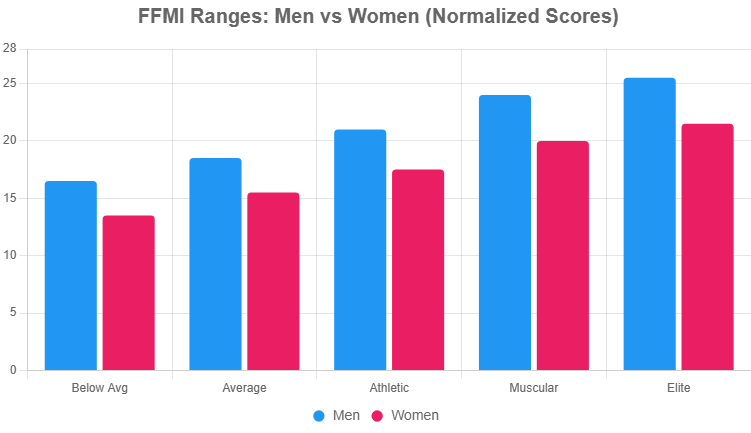
    Here’s the truth: a universal FFMI chart doesn’t work. A gender FFMI comparison is essential because men and women have different physiological makeups. Applying the same standards to both would be misleading and discouraging. Gender-specific ranges give you a much more accurate picture of your progress.

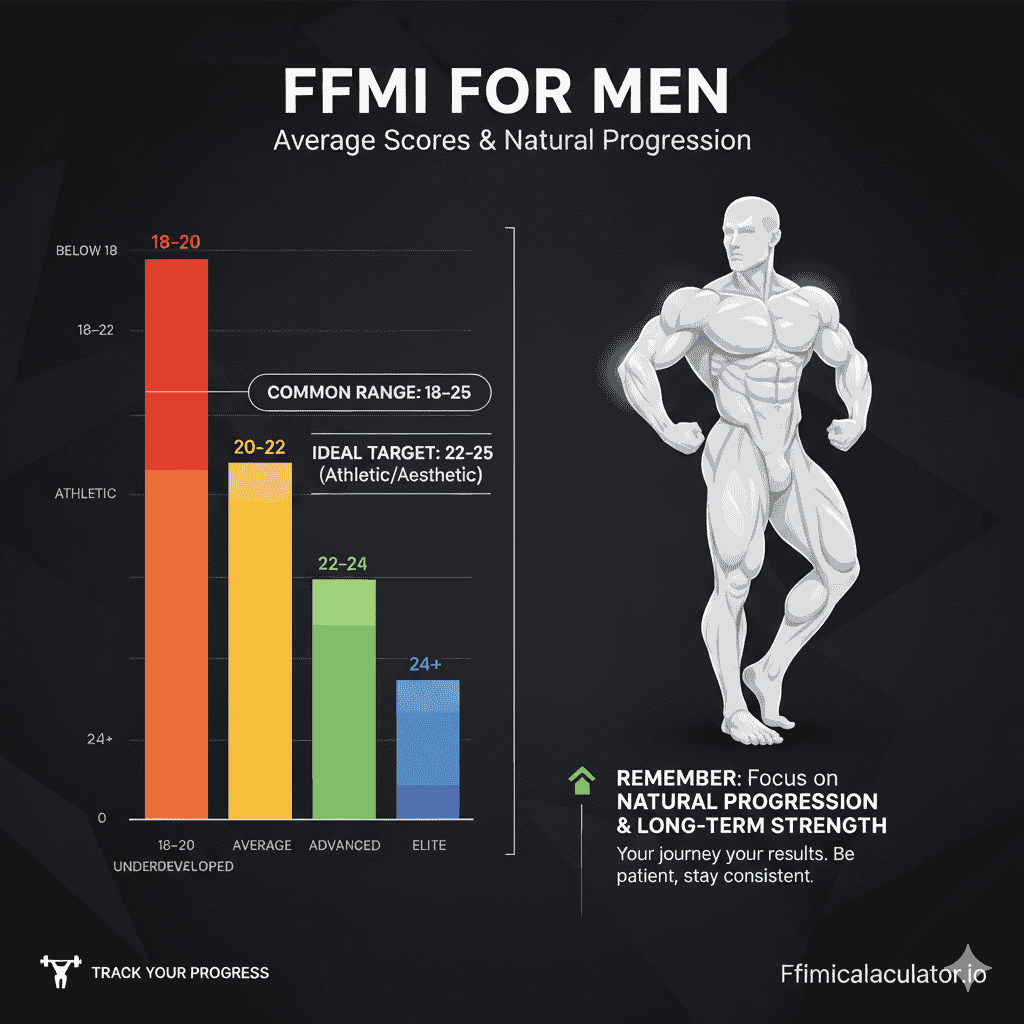
    FFMI for Men — Average and Ideal Scores

    For men, FFMI is an excellent way to track muscular development. The scores provide a clear roadmap from an average build to an elite natural physique. Knowing where you stand can help you set powerful and achievable goals.

    FFMI for Men

    Let’s break this down with a simple chart for the average FFMI score and ideal FFMI range for men.

    FFMI RangeCategoryMeaning
    16–17Below AverageIndicates low muscle mass for your frame.
    18–19AverageTypical for a healthy, non-lifting individual.
    20–22AthleticShows a fit and consistently trained physique.
    23–25MuscularRepresents an elite natural physique.
    25+Likely EnhancedA score very difficult to achieve naturally.

    Most men who train consistently with weights will find themselves in the 20–23 FFMI range. This is a fantastic achievement that shows clear dedication. Pushing into the 23–25 range is a sign of exceptional genetics and years of hard work. An FFMI for men above 25 is often considered the natural limit.

    If your FFMI is above 23, you’re likely in the top 10% of natural lifters. It’s a score to be proud of.

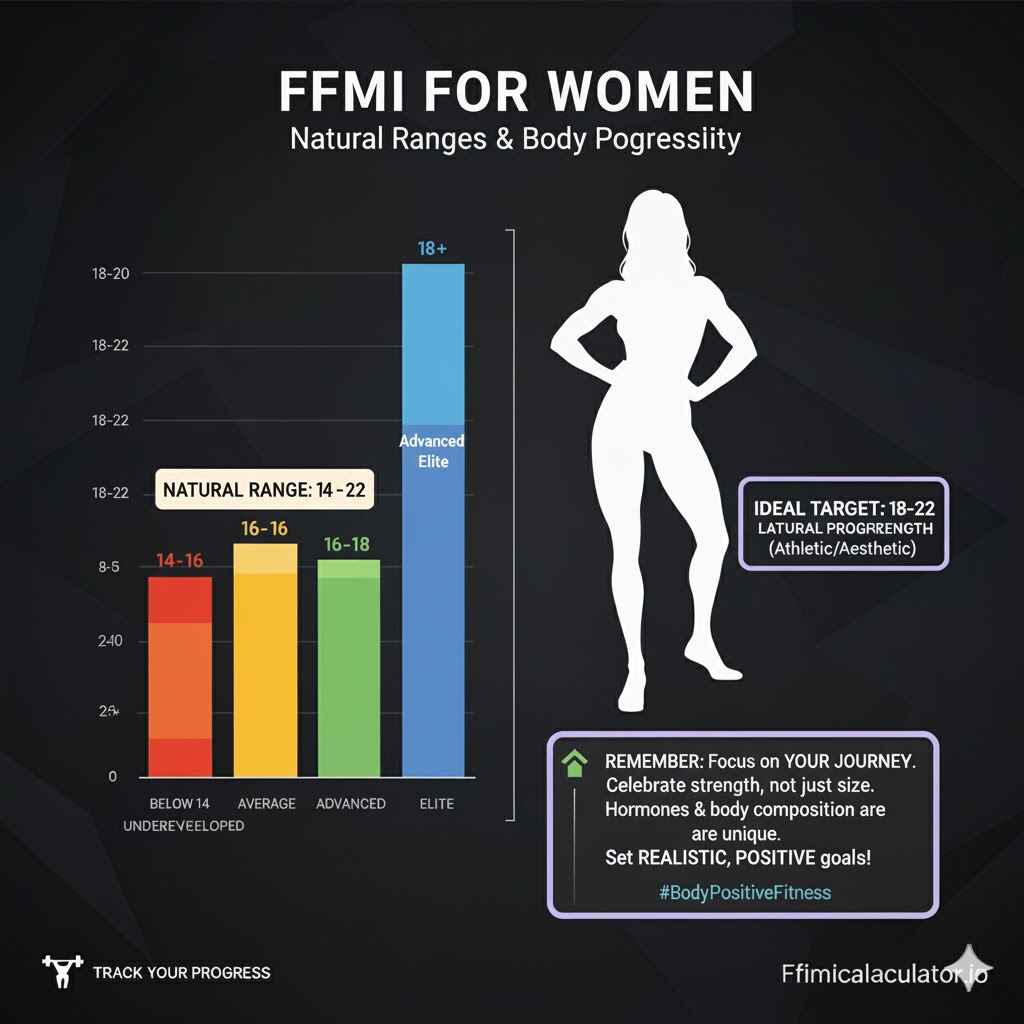
    FFMI for Women — Average and Ideal Scores

    FFMI for women works the same way, but the numbers are different. Women have higher levels of essential body fat and different hormonal profiles, which results in naturally lower FFMI values. However, the progress and dedication required to reach higher scores are just as impressive.

    FFMI for Women

    Here is a look at the FFMI scores for women:

    FFMI RangeCategoryMeaning
    13–14Below AverageSuggests a lower level of lean mass.
    15–16AverageA normal and healthy range for most women.
    17–18AthleticRepresents a fit, toned, and strong physique.
    19–21MuscularTypical for a highly trained female athlete.
    22+Exceptionally MuscularA level that is beyond the typical natural limit.

    A common mistake is to compare the FFMI for women directly to men’s scores. A 17 FFMI for a woman is equivalent to a 22 for a man. Both scores show a strong, athletic build that is the result of consistent effort in the gym and kitchen. Reaching an FFMI of 19 or more as a woman is a sign of elite-level fitness.

    Ready to find out where you stand? You can use our free FFMI Calculator to get your score instantly.

    Why Men Have Higher FFMI Scores

    The difference in the ideal FFMI range between genders is rooted in biology. It’s not about effort or potential, but about fundamental physiological distinctions.

    The primary reason is testosterone. Men produce significantly more testosterone than women, and this hormone plays a crucial role in muscle protein synthesis, the process of building new muscle. This hormonal advantage allows men to build and maintain more muscle mass.

    Other factors include muscle fiber density and body fat distribution. Men tend to have a higher percentage of lean mass, while women naturally carry a higher percentage of essential body fat, particularly for reproductive health. These biological realities are why a gender FFMI comparison is so important for setting fair and accurate benchmarks.

    How to Improve FFMI for Both Genders

    Regardless of gender, the principles for improving your muscle-to-height ratio are the same. It all comes down to a consistent and intelligent approach to training and nutrition.

    • Focus on Resistance Training: This is the most important step. Following a structured workout program with progressive overload will stimulate muscle growth.
    • Eat a High-Protein Diet: Consume enough protein to support muscle repair. Aim for 1.6 to 2.2 grams of protein per kilogram of body weight.
    • Perform Regular Body Checks: Don’t just rely on the scale. Use a tape measure and photos to track visual changes in your body composition.
    • Recalculate Your FFMI: Check your FFMI every 4-6 weeks to ensure your plan is working and to stay motivated on your journey.

    Knowing your numbers is the first step to improving them. You can learn more about what to aim for by reading our guide on what counts as a Good FFMI Score.

    FFMI vs BMI for Men and Women

    For years, the Body Mass Index (BMI) has been the standard for assessing health. However, it’s a flawed metric for active individuals. BMI can’t distinguish between fat and muscle, often mislabeling fit men and women as “overweight” simply because their muscle mass makes them heavier.

    FFMI provides a much fairer assessment for both genders. It rewards you for building a strong, lean body by focusing on your fat-free mass. For anyone who lifts weights or plays sports, FFMI is the superior choice for tracking body composition.

    Final Thoughts

    FFMI is a realistic and motivating tool for measuring your fitness progress. It moves beyond the limitations of BMI and provides a true reflection of your muscularity.

    Remember that men and women have unique ranges. Your progress should be measured by your own consistency and improvements, not by comparing your numbers to someone else’s. The journey is about becoming a stronger version of yourself.

    Take the first step today. Calculate your FFMI and start tracking your progress with a metric that truly understands your hard work.

    FAQs

    What’s an average FFMI for men and women?

    An average FFMI score for men is typically between 18 and 19. For women, an average score is between 15 and 16. These ranges represent a healthy but generally untrained physique.

    Why do women have lower FFMI scores than men?

    Women have naturally lower FFMI scores due to biological differences. These include lower testosterone levels, a higher percentage of essential body fat, and different muscle fiber characteristics.

    Can women reach an FFMI above 20 naturally?

    Yes, it is possible for highly dedicated female athletes with excellent genetics to reach an FFMI of 20 or 21 naturally. This represents an elite level of muscularity.

    What’s considered an elite FFMI score?

    An elite FFMI score for natural male lifters is in the 23–25 range. For natural female lifters, an elite score is in the 19–21 range. These scores require years of dedicated training and nutrition.

    How often should you check your FFMI?

    It is best to check your FFMI every 4 to 6 weeks. This frequency is enough to see meaningful changes without getting bogged down in daily fluctuations. It helps you stay on track and make adjustments to your plan as needed.

  • How To Improve FFMI Naturally (Proven Ways to Build Muscle Without Steroids)

    How To Improve FFMI Naturally (Proven Ways to Build Muscle Without Steroids)

    Many people train hard week after week. They lift heavy, eat well, and stay consistent. Yet, they still look in the mirror and wonder how to get better results. If you want to know how to increase FFMI naturally, you’re asking the right question. It shows you’re focused on what really matters: building lean muscle.

    How To Improve FFMI Naturally

    The Fat-Free Mass Index (FFMI) measures your lean muscle mass relative to your height. Improving your score is a clear sign of real progress. It proves you are building a stronger, more muscular physique. This guide will show you the proven ways to build muscle and improve your FFMI without any shortcuts.

    What Does “Improving FFMI” Mean?

    Let’s break this down. To improve your FFMI, you need to increase your muscle-to-height ratio. This means you are adding lean muscle mass while keeping your body fat in check. It is the core of successful fat-free mass index improvement.

    Gaining weight is easy. Anyone can eat more and see the number on the scale go up. But gaining quality muscle is different. It requires a smart, targeted approach. When you raise your FFMI score, it confirms that the weight you’re adding is primarily lean tissue, not just fat. This is the true goal of any serious lifter.

    If you don’t know your current score, it’s impossible to track your progress. Before you go any further, find your baseline. You can use our free FFMI Calculator to get your score in less than a minute.

    Step 1: Optimize Your Nutrition

    You can’t out-train a bad diet. Nutrition is the foundation for anyone looking to improve FFMI naturally. Your body needs the right fuel to build new muscle tissue. The truth is, without proper nutrition, your efforts in the gym will be wasted.

    First, you must eat enough protein. Protein provides the amino acids that are the building blocks of muscle. Aim for 1.6 to 2.2 grams of protein per kilogram of your body weight daily. This ensures your body has what it needs for muscle repair and growth.

    Next, focus on a modest calorie surplus. To build muscle, you need to consume slightly more calories than your body burns. Aim for an extra 250-500 calories per day. This provides the energy needed for growth without adding excessive body fat.

    Finally, prioritize whole foods. Fuel your body with high-quality sources like lean chicken, fish, eggs, oats, brown rice, nuts, and plenty of vegetables. Also, don’t forget to stay hydrated. Your muscles are about 75% water, and proper hydration is critical for performance and recovery.

    Step 2: Train for Muscle, Not Just Strength

    How you train is just as important as how hard you train. While getting stronger is great, your primary goal for a higher FFMI is building muscle. This is known as hypertrophy training, and it requires a specific approach.

    Focus on a rep range of 8 to 12 reps per set. This range has been proven to be ideal for stimulating muscle growth. Use a controlled tempo, taking about two seconds to lift the weight and three seconds to lower it. This maximizes time under tension, which is a key driver of hypertrophy.

    Your workout plan should be built around compound lifts. Exercises like squats, deadlifts, bench presses, and pull-ups engage multiple muscle groups at once. They are the most efficient exercises for building overall mass and strength.

    Most importantly, you must follow the principle of progressive overload. Each week, you need to challenge your muscles more than the last. You can do this by adding a little more weight, doing one more rep, or performing an extra set. This consistent stimulus is what forces your muscles to adapt and grow.

    The key to a higher FFMI is consistent muscle stimulus, not random workouts. Plan your training and stick to it. This is one of the most effective natural ways to build muscle.

    Step 3: Prioritize Recovery and Sleep

    Here’s the secret that many people overlook: muscle is not built in the gym. It’s built while you rest. Training breaks down your muscle fibers; recovery is when they rebuild bigger and stronger. If you neglect recovery, you will limit your progress.

    Sleep is the most powerful recovery tool you have. During deep sleep, your body releases growth hormone, which is essential for muscle repair. Aim for 7 to 9 hours of quality sleep every night. Make it a non-negotiable part of your routine.

    You also need to manage your stress levels. Chronic stress increases cortisol, a hormone that can break down muscle tissue and promote fat storage. Find healthy ways to unwind, whether it’s through meditation, walking, or a hobby.

    Finally, take your rest days seriously. Your muscles need time to fully recover between intense workouts. Training seven days a week is a recipe for overtraining and burnout. Listen to your body and give it the downtime it needs to achieve fat-free mass index improvement.

    Step 4: Track Body Composition Changes

    To ensure you’re on the right path, you need to track your progress. This goes beyond just weighing yourself. You need to monitor your body composition to make sure you are gaining muscle, not just fat.

    Use a combination of tools. A scale will track your total weight. A tape measure will help you see if your chest, arms, and legs are growing while your waist stays trim. The mirror is also a powerful tool for seeing visual changes in your physique.

    Recalculate your FFMI every 4 to 6 weeks. This will give you concrete data on whether your training and nutrition plan is working. If your FFMI is increasing, you know you’re on the right track. If it’s stagnant, you know it’s time to make adjustments. This feedback loop is crucial to raise your FFMI score over time.

    While tracking, it’s helpful to know what benchmarks to aim for. Read our guide on What Is a Good FFMI Score to understand the ranges for your experience level.

    Step 5: Stay Natural and Consistent

    The journey to increase FFMI is a marathon, not a sprint. It’s about consistency and patience. There are no magic pills or shortcuts. Real, lasting progress is built day by day, workout by workout.

    Embrace the natural process. It’s tempting to look for quick fixes, but performance-enhancing drugs come with serious health risks and aren’t necessary for an impressive physique. The truth is that reaching an FFMI of 24–25 is an elite accomplishment, but it is achievable for dedicated natural lifters over many years. Real progress is built, not injected.

    Stay consistent with your nutrition, training, and recovery. There will be days you don’t feel motivated, but those are the days that count the most. Trust the process and celebrate the small wins along the way.

    Common Mistakes That Limit FFMI Growth

    Many people work hard but make simple errors that hold them back. Avoiding these common mistakes is one of the best natural ways to build muscle.

    • Undereating: You can’t build a house without bricks. Don’t be afraid of a small calorie surplus.
    • Overtraining: More is not always better. Your body needs rest to grow.
    • Ignoring Recovery: Skipping sleep and living with high stress will kill your gains.
    • Skipping Progressive Overload: Doing the same workout for months will lead to a plateau.

    Here is a quick checklist to keep you on track:

    MistakeDo This Instead
    UndereatingEat in a slight calorie surplus (250-500 extra calories).
    OvertrainingTrain 3-5 days per week and take dedicated rest days.
    Poor SleepAim for 7-9 hours of quality sleep per night.
    Random WorkoutsFollow a structured plan with progressive overload.

    Final Thoughts

    Improving your FFMI naturally is a rewarding journey that proves your dedication. It’s a long-term process that relies on the fundamentals: consistent training, smart nutrition, and dedicated recovery. There are no secrets, only principles.

    By focusing on these proven steps, you can effectively build lean muscle and transform your physique. You have the power to build the body you want. It just takes discipline and patience.

    Ready to start your journey? Calculate your FFMI today and begin tracking your progress toward a stronger, more muscular you.

    FAQs

    How long does it take to improve FFMI naturally?

    For a beginner, noticeable improvement can be seen in 3-6 months with consistent effort. For intermediate or advanced lifters, progress is slower, and it may take 6-12 months to see a significant increase in your FFMI score.

    Can you increase FFMI without supplements?

    Absolutely. Supplements can be helpful but are not necessary. You can achieve excellent fat-free mass index improvement with a solid nutrition plan based on whole foods, a smart training program, and adequate rest.

    What diet helps improve FFMI fastest?

    A diet that supports muscle growth is key. This includes a slight calorie surplus (250-500 extra calories daily), high protein intake (1.6-2.2g per kg of body weight), and a focus on nutrient-dense whole foods.

    Does age affect FFMI improvement?

    Yes, age can affect the rate of muscle growth. It’s typically easiest to build muscle in your 20s and 30s. However, people of all ages can increase their FFMI with proper training and nutrition.

    Is FFMI the best measure of muscle growth?

    For athletes and lifters, FFMI is one of the best metrics available. It is far superior to BMI because it isolates lean muscle mass from fat, providing a true measure of your muscularity relative to your height.

  • What Is a Good FFMI Score? (Natural Limit and Ideal Range)

    What Is a Good FFMI Score? (Natural Limit and Ideal Range)

    You’ve been hitting the gym for months, maybe even years. You’re stronger, your clothes fit differently, and you can see new muscle in the mirror. But then you ask yourself a simple question: Is my progress actually good? It’s a common thought for anyone serious about fitness. You want a real way to measure your gains, not just go by how you feel.

    What Is a Good FFMI Score

    This is where the Fat-Free Mass Index (FFMI) comes in. It’s a powerful tool that answers the question of how muscular you truly are for your height. FFMI helps you understand your body composition on a deeper level, moving beyond just the number on the scale. It provides a clear muscle-to-height ratio, giving you a benchmark for your hard work.

    What Does FFMI Measure?

    In simple terms, the Fat-Free Mass Index measures how much muscle you have relative to your height. It isolates your lean body mass—which includes muscles, bones, and organs—from your fat mass. This is a huge step up from just looking at your total weight, which can be very misleading.

    Here’s the truth: two people can have the same height and weight but look completely different. One might have a high body fat percentage, while the other is lean and muscular. FFMI accounts for this by requiring your body fat percentage in its calculation. It gives you a score that directly reflects your muscularity. If you’re new to this concept, our FFMI vs BMI comparison explains why this metric is far superior for athletes.

    Understanding aGood FFMI Score?

    So, what exactly is a good FFMI score? It’s not a one-size-fits-all answer. A “good” score depends on several factors, including your gender, genetics, and how long you’ve been training. A beginner’s ideal FFMI range will look very different from that of an elite athlete.

    Men naturally carry more muscle mass than women, so their FFMI scores will be higher. Genetics also play a big role in your potential for muscle growth. Some people are just born with a framework that allows them to pack on muscle more easily. Finally, your training experience matters. The longer and more consistently you train, the higher your FFMI score is likely to be.

    FFMI Score Chart (Men & Women)

    To give you a clearer picture, we can break down FFMI scores into different categories. This FFMI chart helps you see where you stand and what you can aim for. Remember, these are general guidelines, but they provide an excellent reference point.

    Now let’s break this down for both men and women.

    FFMI Score Chart (Men & Women)

    FFMI for Men

    For men, a good FFMI score reflects a solid amount of muscle mass. Here’s how the numbers typically stack up:

    FFMI ScoreCategory
    16–17Below Average
    18–19Average
    20–22Athletic
    23–25Muscular
    25+Enhanced or Exceptionally Gifted

    An average, non-lifting man will usually fall in the 18-19 range. Once you start training seriously and consistently, you can push into the athletic and muscular categories. Reaching an FFMI of 23 or higher signifies a very impressive and well-developed physique that stands out.

    FFMI for Women

    The ideal FFMI range for women is naturally lower than for men due to hormonal and physiological differences. However, the same principles of progress apply. Here is a general FFMI chart for women:

    FFMI ScoreCategory
    13–14Below Average
    15–16Average
    17–18Athletic
    19–21Muscular
    22+Exceptionally Muscular

    An FFMI for men and women differs, and that’s perfectly normal. For women, a score in the 17–18 range indicates a strong, athletic build. Pushing into the 19–21 range means you have achieved a level of muscularity that is noticeable and well above average.

    The Natural FFMI Limit

    A common question is, What’s the highest FFMI score I can achieve naturally? This brings us to the concept of the natural FFMI limit. Based on research and analysis of elite natural bodybuilders from before the steroid era, a consensus has formed around this topic.

    For men, the natural FFMI limit is generally considered to be around 25. For women, it’s around 22. Let’s be honest—very few people naturally exceed these numbers. Reaching or surpassing this threshold often suggests either a top-tier genetic predisposition for muscle growth or the use of performance-enhancing substances. This natural FFMI limit provides a realistic ceiling for what most people can aim for with dedication.

    What’s a Healthy FFMI Range?

    While it’s exciting to think about the maximum limit, it’s more practical to focus on a healthy and achievable FFMI range for your experience level. Your goal should be progressive improvement.

    Here’s a look at some realistic targets:

    • Beginners (less than a year of consistent training): Men can aim for an FFMI of 17–19, while women can target a score of 14–15. This range indicates you are building a solid foundation.
    • Intermediates (1–3 years of training): Trained men can realistically achieve an FFMI of 20–23. Women in this category can shoot for a score between 16 and 18. This shows significant progress and an athletic physique.
    • Elite Naturals (5+ years of dedicated training): With years of hard work, elite natural men can reach an FFMI of 23–25. Elite women can achieve an impressive score of 19–21. This represents the peak of natural potential for most.

    Setting goals based on these stages helps you stay motivated and track your progress effectively. The key is consistency over time.

    How to Improve Your FFMI Score Naturally

    Improving your FFMI score comes down to building lean muscle mass while managing body fat. There are no shortcuts, but a few fundamental principles will drive your success. You can improve your muscle-to-height ratio with a smart approach.

    Here are four actionable tips:

    1. Prioritize Protein: Protein is the building block of muscle. Aim to consume between 1.6 to 2.2 grams of protein per kilogram of your body weight each day to support muscle repair and growth.
    2. Focus on Progressive Overload: To build muscle, you must consistently challenge your body. This means gradually increasing the weight, reps, or sets in your workouts over time.
    3. Get Enough Sleep: Muscle growth happens when you rest, not when you train. Aim for 7–9 hours of quality sleep per night to allow your body to recover and rebuild.
    4. Manage Stress and Recovery: High stress levels can hinder muscle growth by increasing cortisol. Make time for active recovery, like stretching or walking, and manage stress through mindfulness or hobbies.

    Following these tips will put you on the right track to boosting your score.

    Final Thoughts

    FFMI is without a doubt one of the most accurate ways to measure your muscularity. It cuts through the noise of the bathroom scale and tells you what you really want to know: how much lean muscle you’ve built. Understanding what a good FFMI score is for your body and experience level is a game-changer.

    Knowing your score helps you set realistic goals and appreciate the progress you’ve made. It provides a clear benchmark that reflects your hard work and dedication in the gym. Instead of guessing, get an accurate reading of your physique.

    Ready to find out where you stand? Use our free FFMI Calculator to get your score in seconds.

    FAQs

    What is considered a good FFMI score?

    A good FFMI score is relative to your gender and training experience. For men, a score of 20–22 is considered athletic, while 23–25 is very muscular. For women, 17–18 is athletic, and 19–21 is considered muscular.

    What’s the natural FFMI limit for men and women?

    The widely accepted natural FFMI limit is around 25 for men and 22 for women. Achieving scores beyond this naturally is extremely rare and typically requires elite genetics.

    Can you increase FFMI with diet alone?

    While diet, especially protein intake, is crucial for supporting muscle, you cannot significantly increase your FFMI without resistance training. Building muscle requires a stimulus from exercise, primarily weightlifting.

    Is FFMI better than BMI?

    For anyone who is active or has a good amount of muscle, FFMI is far better than BMI. FFMI distinguishes between muscle and fat, providing a true measure of body composition, whereas BMI does not.

    How can I calculate FFMI easily?

    The easiest way to calculate your FFMI is by using an online tool. You will need to know your height, weight, and body fat percentage. An online calculator does the complex math for you instantly.

  • FFMI vs BMI — Which One Shows Real Fitness? 2026

    FFMI vs BMI — Which One Shows Real Fitness? 2026

    Have you ever hit the gym consistently, built serious muscle, and felt stronger than ever, only to be told your Body Mass Index (BMI) labels you as “overweight”? It’s a frustrating and common experience for many fitness enthusiasts. This happens because traditional health metrics often fail to see the whole picture. They can’t tell the difference between fat and muscle.

    Here’s the thing though… there is a much better way to measure your progress. Enter the Fat-Free Mass Index (FFMI). This advanced metric offers a fairer, more accurate look at your body composition. It focuses on your muscle mass, not just your total weight. This article explores the FFMI vs BMI debate and explains why one is a better fitness index for active people.

    What Is BMI?

    Body Mass Index, or BMI, is a simple tool used for over a century to estimate body fat. It uses a straightforward formula: your weight in kilograms divided by the square of your height in meters. Doctors and public health organizations use it to quickly categorize individuals as underweight, normal weight, overweight, or obese. It’s a quick and easy population-level screening tool.

    But most people don’t realize BMI ignores muscle mass entirely. For a bodybuilder or anyone who lifts weights seriously, this is a huge flaw. Muscle is much denser than fat. A muscular person can easily have a high BMI that incorrectly places them in the “overweight” or “obese” category, even with a very low body fat percentage. This is why a standard BMI calculator can be so misleading for athletes.

    What Is FFMI?

    Now, you might be wondering what FFMI is and how it’s different. The Fat-Free Mass Index (FFMI) is a more specialized body composition measurement. It calculates your muscle mass relative to your height. Unlike BMI, it separates your fat-free mass (muscles, bones, organs) from your fat mass. This gives you a clear picture of how much lean muscle you actually carry.

    The fat-free mass index formula requires three key numbers: your height, weight, and body fat percentage. Because it accounts for body fat, FFMI is highly trusted by fitness experts, bodybuilders, and researchers. It provides a true measure of muscularity. We believe strongly that FFMI is the fairer metric for athletes and anyone serious about their fitness journey.

    FFMI vs BMI — Key Differences

    The core difference between FFMI and BMI is what they measure. BMI looks at your total weight, while FFMI focuses specifically on your muscle. This distinction is crucial for understanding your true fitness level. One measures mass, the other measures lean muscle.

    Let’s look at a table to see the main differences.

    FeatureBody Mass Index (BMI)Fat-Free Mass Index (FFMI)
    Primary FocusTotal body weight relative to heightMuscle mass relative to height
    Accounts for MuscleNo. It treats muscle and fat the same.Yes. It separates fat-free mass from fat.
    Accuracy for AthletesLow. Often mislabels muscular people.High. Provides an accurate muscularity score.
    Required InputsHeight and WeightHeight, Weight, and Body Fat Percentage

    To see the difference in action, consider this example. A 6-foot-tall, 220-pound athlete with 10% body fat would have a BMI of 29.8. This number labels him as “overweight.” However, his FFMI would be around 27.2, which is an excellent score indicating significant muscle development.

    An average person of the same height and weight but with 30% body fat would have the same “overweight” BMI. But their FFMI would be a much lower 21.2, showing a clear difference in body composition. This highlights the problem with relying on a BMI vs FFMI calculator for active people.

    When to Use Each Metric

    Honestly, it depends on the situation. BMI isn’t completely useless. It serves as a decent starting point for the general, sedentary population. If someone doesn’t exercise regularly and has a high BMI, it can be a reliable indicator of excess body fat. It helps doctors quickly assess health risks in large groups of people.

    However, if you lift weights, play sports, or have an athletic build, FFMI gives you much better insight. It answers the question, “How much of my weight is actually muscle?” It’s the superior tool for tracking muscle growth, setting realistic fitness goals, and understanding your body composition on a deeper level. When deciding which is better, BMI or FFMI, your activity level is the key factor.

    How to Calculate FFMI Easily

    Calculating your FFMI is easier than you might think. You just need three measurements.

    1. Measure Your Weight: Use a scale to find your current weight in pounds or kilograms.
    2. Measure Your Height: Get an accurate measurement of your height in feet and inches or meters.
    3. Determine Your Body Fat Percentage: This is the trickiest part. You can get a good estimate using skin fold calipers, a body fat scale, or a professional DEXA scan.

    Once you have these three numbers, you can use the FFMI formula. However, the math can be a bit complex. The easiest way to get your score is to use a digital tool.

    You can find your score in seconds with our free FFMI Calculator. Just enter your details and let it do the work for you.

    Final Thoughts

    When comparing FFMI vs BMI, the winner is clear for anyone who values muscle. While BMI has its place as a general health indicator, it falls short for active individuals. It simply cannot tell the difference between a pound of muscle and a pound of fat.

    FFMI provides the clarity that BMI lacks. It honors the hard work you put into building a strong, lean physique by focusing on your muscle mass. It offers a true fitness index that reflects your dedication. Stop letting a flawed metric define your progress. We encourage you to calculate your FFMI and gain a better understanding of your real fitness level.

    FAQs

    Is FFMI better than BMI?

    For athletes, bodybuilders, and active people, yes. FFMI is a much better indicator of body composition because it isolates muscle mass. BMI is only useful for the general sedentary population as a quick health screening tool.

    Can FFMI detect steroid use?

    Some research suggests that a normalized FFMI score above 25 is difficult to achieve naturally. Scores approaching 26-27 or higher are often viewed with suspicion in the fitness community, though it is not definitive proof of steroid use.

    What’s a good FFMI range for men and women?

    FFMI ranges differ by gender. For men, an FFMI of 18-20 is average, while 20-22 is considered above average. A score of 23-25 indicates a very muscular build. For women, 14-16 is average, 16-18 is above average, and anything over 19 is considered very muscular.

    How is FFMI calculated?

    FFMI is calculated using a formula that incorporates your height, weight, and body fat percentage. It first determines your fat-free mass (your total weight minus your fat mass). Then, it adjusts that number for your height to produce an index score. An online FFMI calculator is the simplest way to find your score.

As an Amazon Associate I earn from qualifying purchases. ffmicalculator.io is a participant in the Amazon Services LLC Associates Program.